
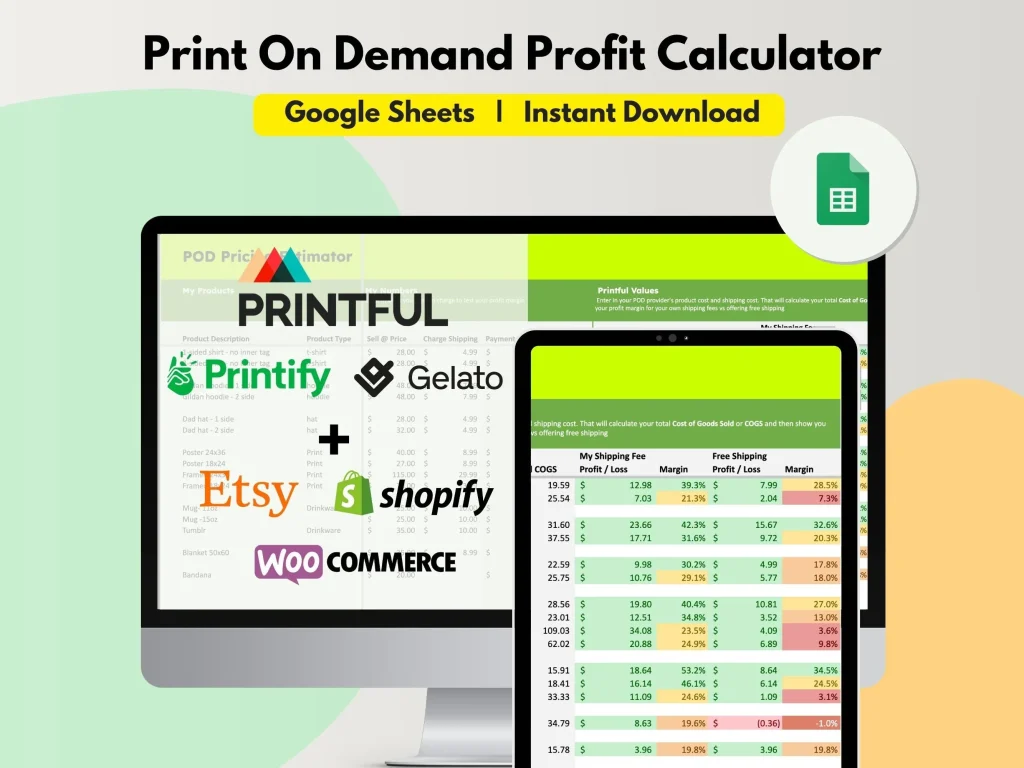
Print on Demand pricing sets the baseline for profitability, brand integrity, and scalable growth in a business that ships products only after purchase, reducing waste while keeping options open for experimentation. A thoughtful print on demand pricing strategy weighs unit costs, shipping, platform fees, and the value your designs deliver, ensuring you don’t underprice quality or overprice perception in competitive markets. This POD pricing guide helps you translate costs into a fair, compelling price by outlining landed costs, margins, and psychological pricing ideas—while also showing how to price print on demand products without eroding brand value. Keep your focus on POD profit margins by balancing cost recovery with perceived value, so customers feel they are paying for quality, customization, and reliable fulfillment rather than simply chasing the lowest price. As you read, you’ll find practical steps, illustrated examples, and cautionary notes designed for pricing your POD storefront with confidence and consistency across channels.
Viewed through an alternative lens, the topic becomes about cost-based pricing, value-driven valuation, and margin optimization that align with your unit economics. You can discuss price positioning, tiered bundles, and dynamic or geographic pricing as practical tools to balance coverage of costs with consumer willingness to pay. Framed this way, the challenge centers on communicating quality and reliability while steering buyers toward options that increase average order value without sacrificing margins.
Understanding the true Cost Base for POD Pricing and Its Impact on POD Profit Margins
Understanding the true cost base is the foundation of effective POD pricing. Landed cost per unit includes the base product price from your POD provider, per-item fulfillment and shipping, and any add-ons or rush options that customers may choose. When you allocate a fair portion of overhead and marketing to each unit, you protect POD profit margins and prevent hidden losses from eroding margins as you scale.
Relying on the base cost alone is the most common pricing mistake in print on demand. A complete POD pricing strategy requires recognizing all cost elements and the value you deliver. By mapping costs to customer-perceived value, you position your offerings to sustain healthy margins while staying credible to buyers.
Print on Demand pricing: A Practical POD Pricing Guide
This practical guide to pricing covers how to translate landed costs into market-ready prices. The POD pricing guide emphasizes calculating base costs, shipping, platform fees, and desired margins so you can set transparent, defensible prices that support growth and reliability.
To answer how to price print on demand products, you combine math with value signals like design quality, customization options, and niche appeal. Start with a simple baseline price using the landed cost, then test and refine with small increments, regional adjustments, and bundled offers to protect POD profit margins.
Aligning Pricing with Brand Positioning and Customer Willingness to Pay
Pricing your POD storefront should reflect where your brand sits in the market and how much customers in your niche are willing to pay for quality and reliability. A premium positioning justifies higher prices built on materials, durability, and a superior unboxing experience.
Use price elasticity insights to create a price ladder that preserves margins while capturing different customer segments. This is where you map value to price and avoid underpricing or overpricing that damages brand equity.
Strategies for Different POD Products and Niches: Cost-Plus, Value-Based, Bundles
Different product types respond to different strategies. Mass-market apparel may perform well with cost-plus pricing and predictable margins, while art prints and premium accessories benefit from value-based pricing that reflects uniqueness and durability.
Bundles, tiers, and add-on options can lift average order value, especially when paired with clear value statements. A practical POD pricing strategy combines these approaches to balance margin and perceived value.
Tactics for Maximizing Margin: Bundles, Tiering, Geography, and Seasonal Adjustments
Tiered pricing and bundled offers create choice without eroding margins. Geography-aware pricing helps stay competitive in different markets while recognizing shipping realities and duties.
Seasonal pricing can capture demand spikes, but should be applied with governance to prevent price volatility that confuses customers. These tactics form a core part of pricing your POD storefront for sustained profitability.
Measuring Performance and Iterating: KPIs, Cadence, and Pricing Your POD Storefront
Ongoing measurement is essential to protect POD profit margins. Track gross margin per unit, overall margins, and changes in AOV and conversion rates as you adjust prices.
Set a pricing cadence—monthly checks for minor shifts, quarterly strategy reviews for seasonality and new designs, and annual refreshes to align with brand positioning and market shifts. This disciplined approach ensures pricing your POD storefront stays aligned with business goals.
Frequently Asked Questions
What is a POD pricing guide and how does print on demand pricing fit into it?
A POD pricing guide is a framework for pricing that ensures you cover costs, reflect value, and maintain healthy margins. In this framework, print on demand pricing starts with understanding the full landed cost (base product cost, fulfillment/shipping, platform fees, add-ons, and allocated overhead) and then applying a target margin (a common range is 30–60%). You derive a baseline price with price = landed cost / (1 – target margin) and then adjust for value, psychology, and market fit before testing in the real market.
How to price print on demand products to protect POD profit margins and drive sales?
Follow a three-part approach: 1) compute landed cost per unit (base cost + shipping + add-ons + allocated overhead); 2) set a target margin (30–60% gross is common) and calculate a baseline price with price = landed cost / (1 – margin); 3) adjust for value and market fit (bundle options, bundle pricing, psychological pricing), then test and iterate. For example, if landed cost is $8 and you target a 40% margin, the baseline price is $13.33 (often rounded to $13.99). In higher-value niches, you might price higher (e.g., $16.99–$17.99) and use bundles like 2 for $29.99 to lift AOV while preserving margins.
What are the key components of the landed cost per unit in a print on demand pricing strategy?
– Base product cost (printing item) – Fulfillment and shipping per unit – Platform fees and payment processing – Add-ons and options (premium print, embroidery, rush production) – Allocated overhead and marketing costs. Understanding these components helps avoid pricing only by the base cost and ensures margins stay healthy as you scale.
How should you price your POD storefront using cost-plus and value-based methods in a POD pricing guide?
Two common approaches are: 1) Cost-plus pricing, which adds a fixed margin on top of the landed cost for a simple, steady-profit strategy; 2) Value-based pricing, which bases the price on the customer’s perceived value, niche demand, and material or design differences, allowing higher prices in premium segments. Practical steps: compute landed cost, select your approach, set the price (and consider tiers or bundles), then test and adjust based on market response and margins.
How can you apply A/B testing and market research in the POD pricing guide to optimize pricing?
Use A/B testing to compare two price points on similar customer segments and monitor results such as revenue, gross margin, average order value, and conversion rate. Pair this with ongoing market research by watching competitors, assessing demand changes, and evaluating perceived value. Establish a cadence (monthly price checks, quarterly strategy reviews) and ensure tests are statistically sound to inform pricing decisions.
What common pitfalls should you avoid when learning how to price print on demand products or following a print on demand pricing strategy?
Avoid overreliance on base cost alone and ignoring shipping, platform fees, and overhead. Don’t fall into discount fatigue or price volatility across channels. Watch for inconsistent regional pricing, currency effects, and misalignment with brand positioning. Also, don’t skip testing or data-driven reviews—pricing should be revisited as costs, demand, or designs evolve.
| Pricing Topic | Key Points | Practical Takeaways |
|---|---|---|
| Pricing as a Lever | Pricing is the primary lever that affects sales, market share, margins, and brand value. Prices should reflect the value delivered while covering costs and sustaining healthy margins. | Aim for prices that balance value and costs; avoid setting prices too high or too low to protect credibility and profits. |
| Cost Base for POD Pricing | Costs include base product, fulfillment/shipping, platform/processing fees, add-ons, and allocated overhead/marketing. | Don’t rely on base cost alone; account for all costs and the value you deliver to the buyer. |
| Value, Costs, and Mindset | Pricing should balance customer value with costs. Consider willingness to pay, competitive landscape, brand positioning, and price elasticity. | Blend cost-based math with value-driven considerations to signal quality and durability. |
| Pricing Framework (Steps) | 1) Landed cost per unit = base cost + shipping + add-ons + overhead per unit. 2) Target margin (e.g., 30–60%). 3) Baseline price = landed cost / (1 – margin). 4) Adjust for psychology/market fit (rounding, charm pricing, bundles). 5) Test and iterate with price experiments. | Follow the steps to structure prices, then refine based on data. |
| Pricing Strategies by Product/Niche | Cost-plus, value-based, tiered/bundled, dynamic/seasonal, bundle/cross-sell, and geographic pricing. | Choose strategies based on product type and audience; mix approaches to maximize margins and perceived value. |
| Practical Tips & Pitfalls | – Don’t ignore shipping in pricing. – Avoid underpricing. – Watch discount fatigue. – Consider currency/intl pricing. – Protect margins with hedging strategies. – Align pricing with brand story. | Use pricing as part of brand strategy; test changes carefully and communicate value clearly. |
| Tools & Practices | Pricing calculators, A/B testing, market research, and regular data-driven reviews (margins, AOV, conversion). | Build reusable pricing processes and regularly audit performance. |
| Concrete Example | Landed cost per item = $9; target margin = 50%; baseline price = 9 / (1 – 0.50) = $18. Price tested: $18.99; bundles like 2 for $29.99 to increase AOV while preserving margins. | Use real-world numbers to validate pricing decisions and explore value-enhancing bundles. |
| Tracking & Optimization | Monitor gross margin, overall margin, AOV, conversion rate, price elasticity, customer feedback, churn/repeat purchases. | Set a cadence for price checks, monthly tweaks, quarterly strategy reviews, and annual price refreshes. |
| Common Pitfalls (Revisited) | Overreliance on cost-based pricing, large/frequent price changes, inconsistent pricing across channels, and ignoring shipping/taxes. | Be mindful of consistency and the customer-perceived value when adjusting prices. |
Summary
Conclusion: Pricing Print on Demand products for maximum profit requires a balanced approach that accounts for costs, customer value, and market dynamics. By calculating landed costs, setting clear margin targets, and applying appropriate pricing strategies, you can protect margins while delivering compelling offers to your audience. Use the framework outlined here to price POD products thoughtfully, test assumptions, and optimize over time. With careful management of Print on Demand pricing, you’ll build a sustainable business that grows profitably and scales gracefully.